Hermes Agent + Kanban + OpenCode: “Just talk, let it handle the rest”
One-line summary: I send a message on Telegram → the project is registered/cloned → a kanban card is created → an AI worker writes the code → an independent AI reviewer inspects it → if all gates pass, it squash-merges automatically → DNS & deploy pipeline runs. I only interact via Telegram; my phone only buzzes with a 🚧 alert if something gets blocked or needs human decision.
In this post, I break down the end-to-end autonomous development pipeline I built for myself on a single VPS — complete with custom skills, MCPs, automation scripts, and real production learnings.
1. The Big Picture
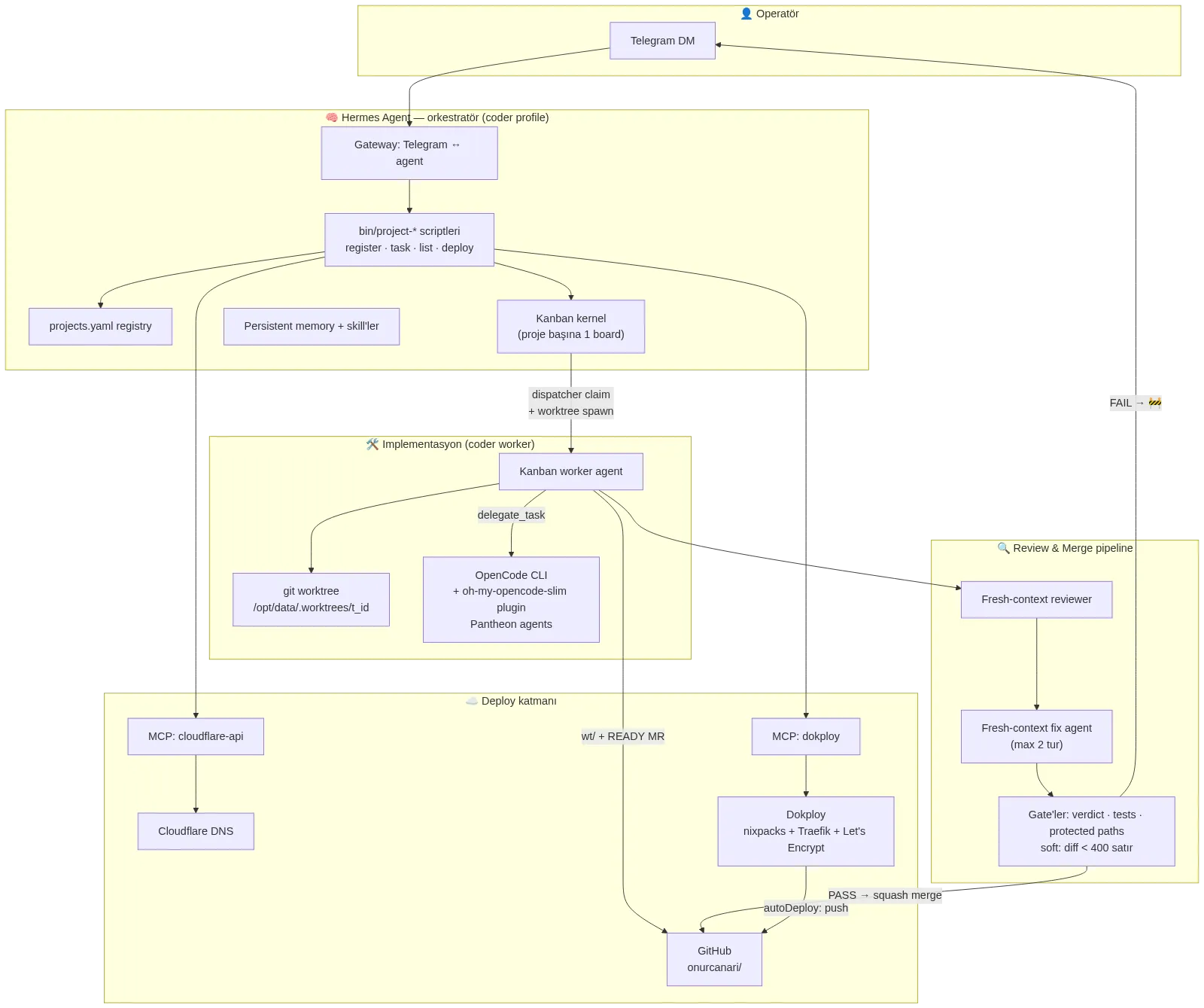
Core design principle: The orchestrator I talk to (my main Hermes session) never writes code directly. The code is written by a dedicated worker agent, and that code is reviewed by a completely separate agent running in a fresh context. The golden rule: No agent is ever allowed to review its own work.
2. Layers & Components
| Layer | Tool | Role |
|---|---|---|
| Interface | Telegram | My single entry point. Commands go in here, status alerts (✅/🚧) come back here. |
| Orchestrator | Hermes Agent (coder profile) | Intent-to-task translation, project registry, dispatcher, and escalation management. |
| Task Queue | Hermes Kanban | One board per project, card lifecycle management, worker spawning, and event logging. |
| Implementation | OpenCode CLI (+ oh-my-opencode-slim) | The tool writing the actual code; spawns sub-agents via delegate_task. |
| Alternative Workers | Claude Code / Codex CLI | Drop-in alternative worker engines (skills are ready). |
| Review | mr-review-merge skill | Independent reviewer + fixer agents with strict gating policies. |
| Git & Hygiene | gh CLI + agent-git-workflow | Isolated git worktrees, branch hygiene, READY MRs, and squash merges. |
| Registry | projects.yaml | Single source of truth: slug → repo path, GitHub slug, and deployment metadata. |
| CLI Scripts | bin/project-{register,task,list,deploy} | Ergonomic wrapper scripts so the orchestrator doesn’t have to fiddle with repetitive commands. |
| Deploy Layer | Dokploy (VPS) + Cloudflare | nixpacks builds, Traefik (80/443), Let’s Encrypt SSL, and auto-deploy on git push. |
| MCPs | cloudflare-api (remote), dokploy (stdio) | Tool servers powering DNS and container deployment automation. |
Skill Chain (Auto-Injected Per Task)
project-task
 ├── agent-git-workflow      → worktree, branch, commit, and push discipline
 ├── opencode                → code implementation delegation
 ├── github-pr-workflow      → PR lifecycle, check, and merge flow
 └── (auto-injected) kanban-worker → card lifecycle and Telegram notification hooks
Review Stage:
 └── mr-review-merge         → reviewer/fixer spawning, gate policies, and squash merge
3. Directory Layout on My VPS
/opt/data/
├── workspace/
│   ├── projects.yaml            ← registry (single source of truth for all projects)
│   ├── bin/
│   │   ├── project-register     ← add/create repo + kanban board + AGENTS.md
│   │   ├── project-task         ← dispatch coding task to board with required skill set
│   │   ├── project-list         ← project overview & board summary
│   │   └── project-deploy       ← DNS → AGENTS.md → Dokploy (strict sequence)
│   └── repos/<slug>/            ← canonical checkouts (main branch is always pristine)
├── .worktrees/t_<task_id>/      ← per-task isolated git worktrees
├── opencode-xdg/config/opencode/opencode.jsonc   ← OpenCode & MCP configurations
├── profiles/coder/              ← my Hermes profile: skills, .env, persistent memory
└── tmp/                         ← throwaway clones used by reviewer and fixer agents
⚠️ Critical pitfall: I NEVER set
default_workdiron kanban boards. When running worktree-based tasks, the dispatcher resolves the workspace dynamically. Setting a static path collapses all concurrent tasks into a single checkout, causing collisions.
4. Flow A — Project Onboarding
Trigger: “Add project X:
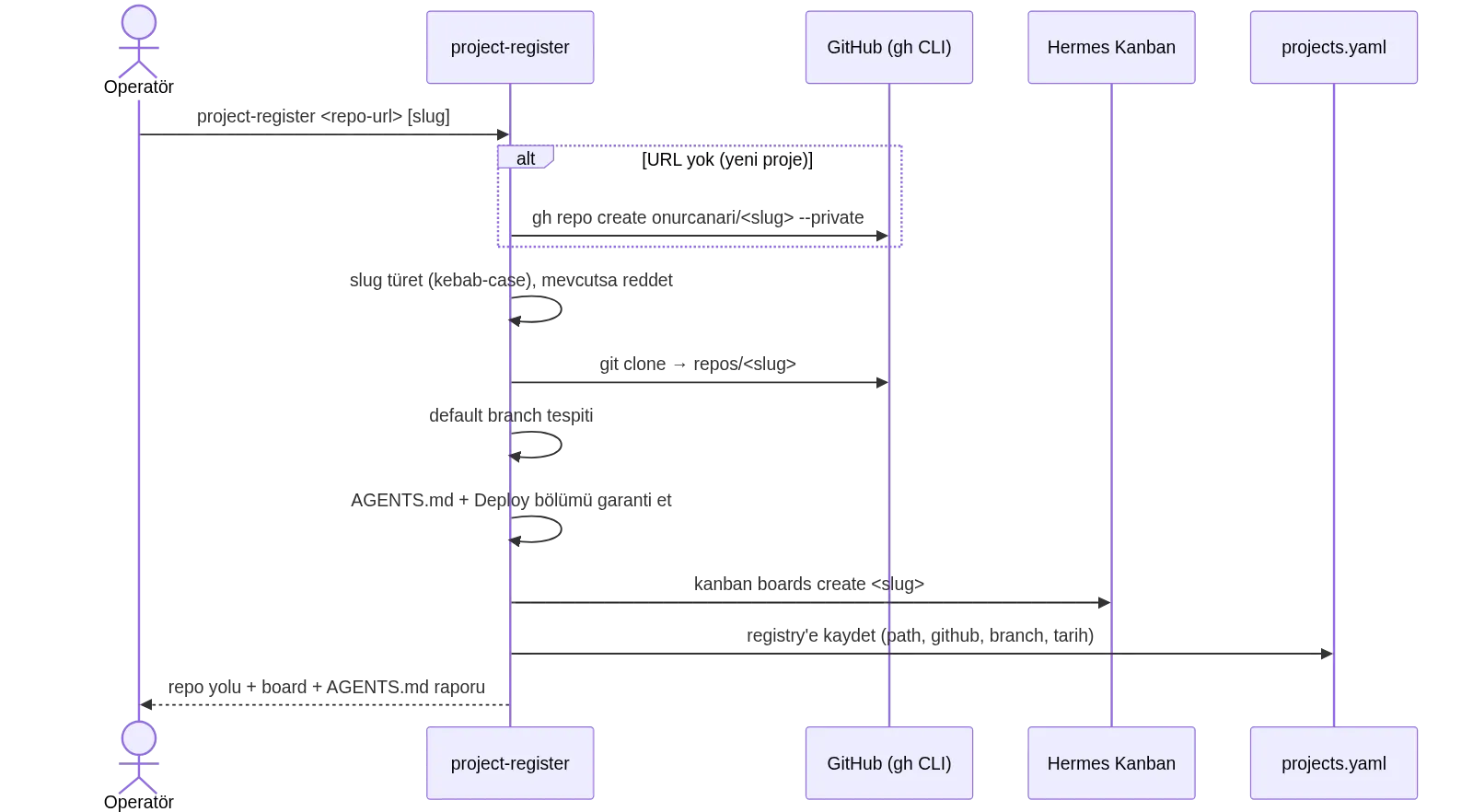
I treat AGENTS.md as the constitution of each project: build, test, and lint commands, along with the Definition of Done (DoD), live there. If a newly registered repository lacks this file, the very first task analyzes the stack and writes a real AGENTS.md. Every subsequent worker and reviewer reads their guidelines directly from it.
5. Flow B — Task Creation & Autonomous Execution
Trigger: “In project X, do this: …”
The single big task rule: No matter how complex a feature is, I always open a single card and explicitly forbid the worker from decomposing it in the task prompt. In practice, a few completely finished cards outperform dozens of half-baked subtasks every time.
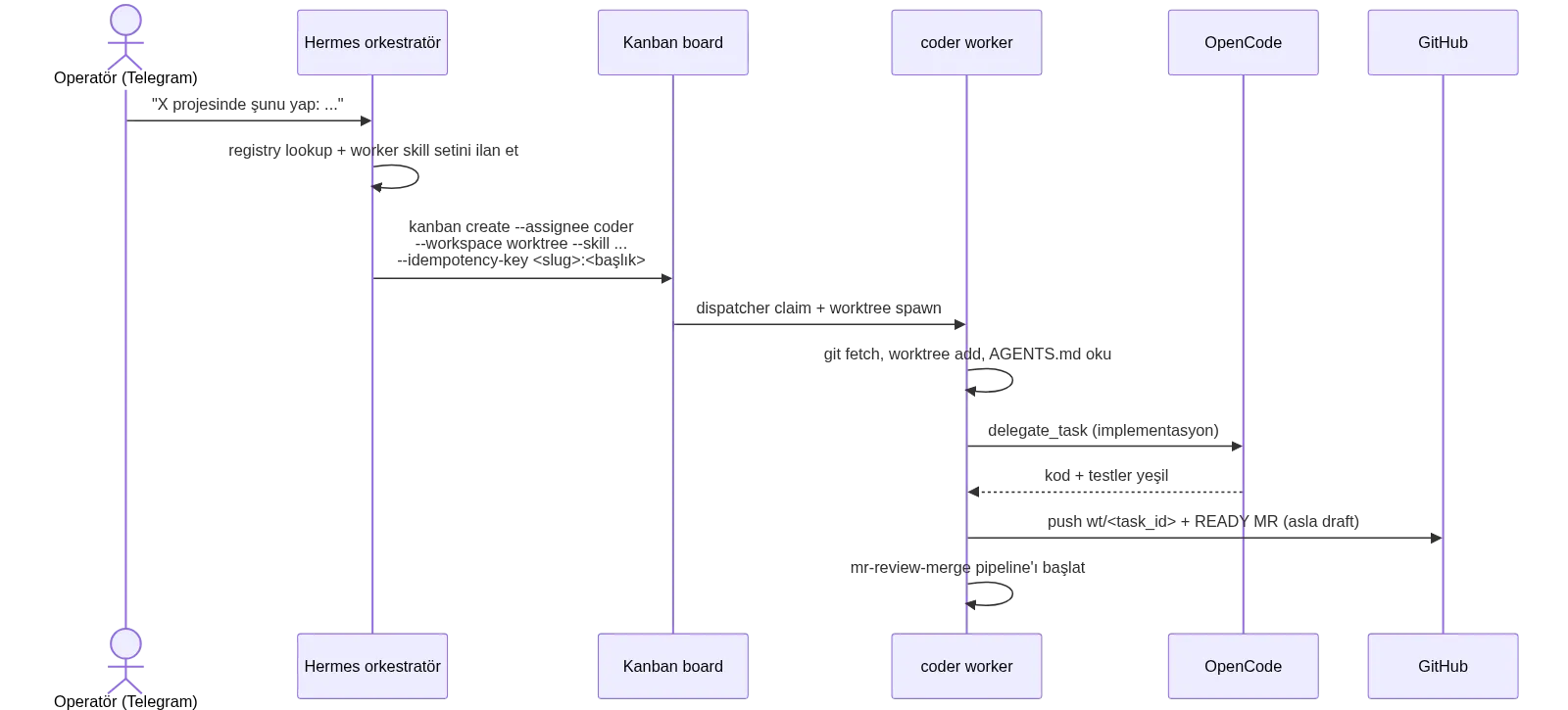
While running, the kanban card transitions from todo → running. Because each project’s board dispatches independently, I can develop multiple projects concurrently without blocking queues.
6. Flow C — Review & Merge Pipeline (The Heart of the System)
Once the worker opens an MR, it doesn’t sit around waiting for me to review it; the review pipeline kicks in immediately. Both sides operate with fresh context: The author cannot review its own code, and the fixer agent focuses on resolving feedback without ego or defending initial choices.
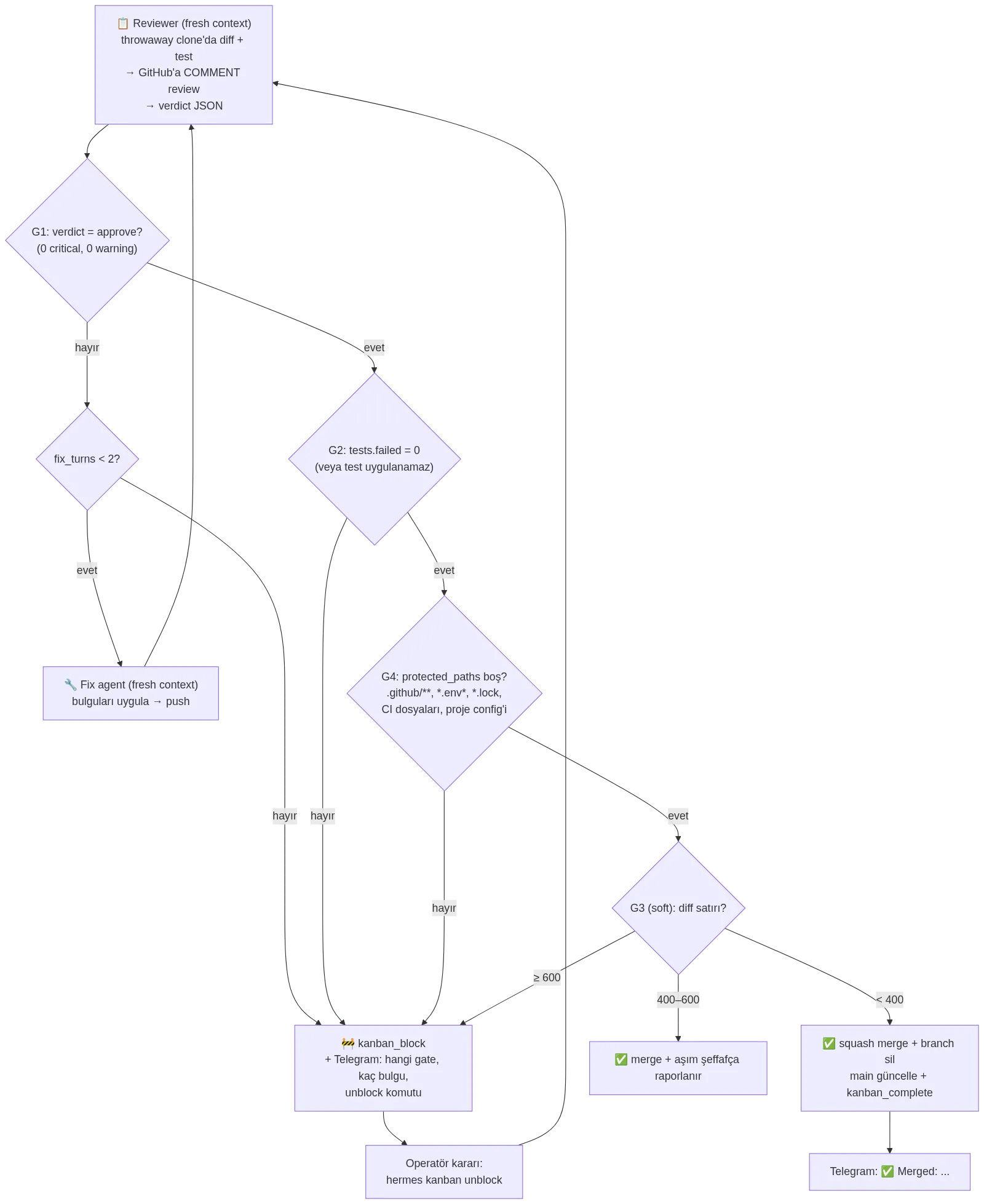
My Quality Gates:
| Gate | Type | Passing Condition | Failure Outcome |
|---|---|---|---|
| G1 Verdict | Hard | approve (0 critical issues, 0 warnings) | Fix turn starts (max 2 turns). If unresolved, escalates to me. Never bypassed. |
| G2 Tests | Hard | tests.failed = 0 (or test suite not applicable) | Escalates. Faking test results is strictly forbidden. |
| G4 Paths | Hard | Protected paths (.env, .github/*, lockfiles, etc.) untouched | Escalates |
(Note: I completely removed the initial diff-size/line-count gate from the current pipeline. When developing an entire mini-game or major feature in a single card, large diffs are completely normal. As long as tests pass, verdict is clean, and protected paths are untouched, it merges regardless of line count.)
The reviewer leaves a COMMENT-type review on GitHub (since self-approval with a single personal access token is blocked by GitHub’s policy) — the merge decision is enforced by the pipeline itself. Reviewers and fixers never work in canonical checkouts; they use throwaway clones in /tmp.
If I jump in and manually merge a PR on GitHub while the pipeline is running, the system handles it gracefully: stranded fix commits are cherry-picked into a fresh MR.
7. Card Lifecycle
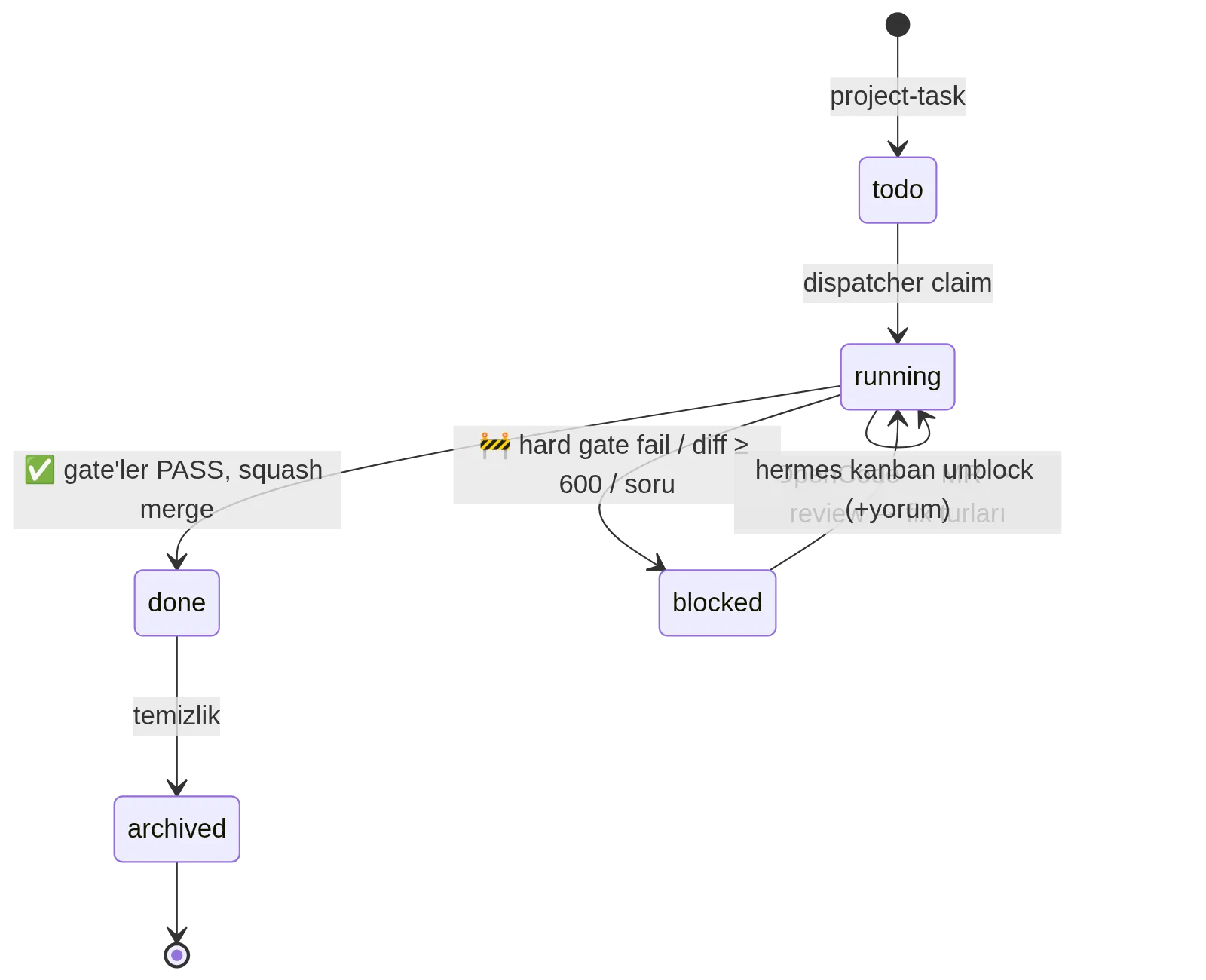
Telegram escalation format (plain text): Task summary + MR link + test results + what is expected from me + one-tap unblock/close command. No news means everything is progressing smoothly in the background; I don’t need to poll or babysit.
8. Flow D — Deployment (Rule: DNS First, Dokploy Second)

- DNS-only (
proxied=false) by default: I keep Cloudflare proxy disabled so Let’s Encrypt HTTP-01 challenges reach the VPS Traefik instance directly. - Onboarding an empty repository sets up DNS, board, and
AGENTS.mdin seconds; the Dokploy container binding takes a single command after the first MR merges. - Deployment parameters are saved in
projects.yamlunderdeploy:(domain, port, app ID), making subsequent deploys completely idempotent.
Live production examples: teletext.onurcanari.com (originally finance-checks; Next.js on nixpacks) and minirumble.lol (Vite + Colyseus on docker-compose).
9. Real Board Snapshot
Here is the actual board distribution for galactic-boredom (a retro PSX-style web game I’ve been building) after about a week of solo development:
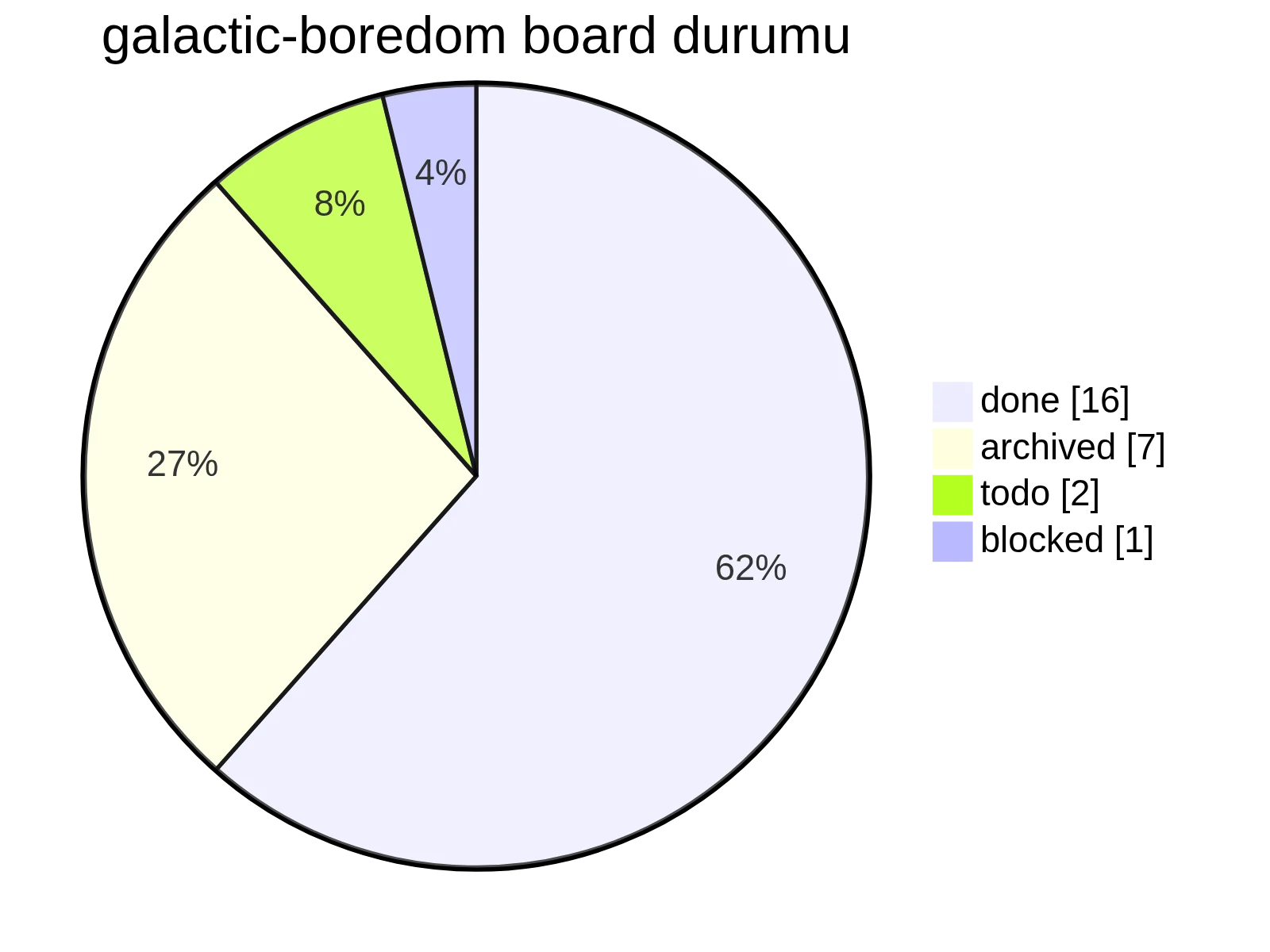
In parallel, teletext ran on its own board without either project waiting on the other.
10. Security & Hygiene Rules
- Secrets never touch docs, chats, task prompts, or git. Tokens live in profile
.envfiles and OpenCodeauth.json; scripts parse them at runtime. - Canonical checkouts are sacred: The
mainbranch only advances via squash-merge or fast-forward pull. Workers and reviewers work in their own isolated sandboxes. - Hard gates are non-negotiable: If the review infrastructure fails or tests break, there is no silent merge — it escalates directly to me.
- Never bypass interactive safety prompts: If a state-changing command pauses for approval in a chat session, handle it explicitly.
- The task body is a contract: Workers must strictly adhere to the defined scope.
11. Step-by-Step Checklist for Replicating This Setup
-
Install Hermes Agent and bind the Telegram gateway to a dedicated profile (e.g.
coder). -
Set up OpenCode CLI, authenticate providers, and optionally add
oh-my-opencode-slimwith your agent presets. -
Prepare the workspace directory layout:
workspace/,workspace/repos/, and.worktrees/. -
Configure the four core scripts:
project-register,project-task,project-list,project-deploy. -
Install the skill bundle:
multi-project(orchestrator),agent-git-workflow+opencode+github-pr-workflow(worker),mr-review-merge(pipeline),kanban-worker(auto-injected).📦 Ready-to-Use Skill Bundle: Download the sanitized archive containing all custom skills, reference manuals, and helper scripts (
ghapi.py,telegram_notify.py,webprobe.py): -
Wire your MCP servers: Cloudflare (remote MCP) and Dokploy (stdio MCP).
-
Install Dokploy on your VPS, configure Traefik (80/443), and connect your GitHub App.
-
Register your first project with
project-registerand dispatch your first task from Telegram.
Hard-Learned Gotchas
- Never set
default_workdiron kanban boards (all parallel tasks will collide on a single checkout). - The
hermesbinary might not be in default shell PATHs — use absolute paths in automation scripts. - Fresh worktree clones lack git identity — ensure
git config user.name/emailis set before commits. - Avoid
parse_mode=Markdownin Telegram bot alerts when branch names or task IDs contain underscores (_), which cause HTTP 400 errors.
12. Why This Architecture?
- Telegram as the primary input: I can trigger features, review diffs, and resolve blockers on the go from my phone with a single sentence.
- Kanban as an asynchronous buffer: Decoupling requests from execution makes work durable, observable, retryable, and parallel. If a session drops, no progress is lost.
- Fresh-context review: Asking an AI agent to critique its own code introduces blind spots. Splitting author, reviewer, and fixer roles dramatically elevated output quality.
- Automated verification gates: Replacing manual code review with deterministic checks (green test suites, zero critical findings, protected path guards) removed the primary bottleneck of solo development.
13. What’s Next? Future Plans & Optimizations
While the system is running smoothly in production, I’m continuously fine-tuning it:
- RAM & Memory Management (8 GB → 16 GB): Running multiple concurrent tasks with heavy parallel builds (
next build,vite build,npm ci) occasionally hit cgroup memory ceilings and triggered OOM kills on 8 GB RAM. I upgraded the VPS to 16 GB, which resolved stability under heavy multi-task loads. - New Skill & Agent Architectures: Planning to integrate specialized skill sets and agents such as Ponytail, Caveman, and RTK to expand coding and research capabilities.
- Token Efficiency: Optimizing prompt structures, context handoffs, and log trimming to further reduce model token consumption and latency.
- Smart Caching in OpenCode: Adding prompt/response caching and build artifact caching to eliminate redundant work.
Note: This post was compiled from my personal notes and production setup on my VPS; editing, tone, and flow were refined with AI assistance.